More About Kai-Zen™
Blog

A Retirement Portfolio Is Not a Retirement Paycheck
For most of your working life, the financial assignment is fairly straightforward: earn, save, invest, repeat.
Retirement changes the assignment.
The deposits slow down or stop. The paycheck disappears. And the portfolio that spent decades receiving money is suddenly expected to start providing it.
That transition is easy to underestimate.
A substantial retirement balance can tell you how much you have accumulated. It does not automatically tell you how much you can comfortably spend each month, where that income should come from, or how long it needs to last.

Accumulation and Distribution Are Different Jobs

During your career, market declines can be uncomfortable, but continued contributions give you time to recover and potentially purchase investments at lower prices.
Retirement introduces a different challenge.
Now money is leaving your portfolio.
If withdrawals are required during a significant market decline, investments may need to be sold when values are down. Those withdrawals leave less capital available to participate in a future recovery.
This is often called sequence-of-returns risk, and it is one reason retirement income planning cannot simply be an extension of the accumulation strategy.
The portfolio has a new job.
Start With the Expenses That Cannot Wait
Before deciding where retirement income should come from, determine what it needs to support.
Housing, food, healthcare, insurance, utilities and other essential obligations continue regardless of what the market does.
Travel, gifts, major purchases, and discretionary spending usually provide more flexibility.
Separating those categories gives the retirement plan a clearer target.
If dependable income sources largely cover essential expenses, there may be less pressure to sell investments during an unfavorable market.
That dependable income might include Social Security, a pension, an annuity, business or rental income, or other sources appropriate to the retiree's circumstances.
The investment portfolio can then be coordinated around the remaining income need rather than being asked to fund everything.
Which Account Pays You First?
Many successful executives reach retirement with several types of assets.
There may be a traditional 401(k), IRA, taxable brokerage account, company stock, cash reserves, deferred compensation and perhaps other income-producing assets.
They do not all behave the same way when money comes out.
Traditional retirement-account withdrawals are generally included in taxable income. Selling appreciated investments in a taxable account can create capital gains. Cash offers immediate liquidity but limited long-term growth potential. Social Security has its own tax considerations.
That makes withdrawal order a planning decision, not simply an administrative one.
Automatically spending one account until it is empty before touching the next may be simple, but simplicity does not necessarily produce the best result.
The better approach depends on income needs, taxes, market conditions, required distributions, estate objectives and the characteristics of each asset.
Market Timing Matters More When the Paycheck Is Gone
No retirement plan can predict exactly what markets will do next.
You should still be prepared for difficult periods.
Imagine retiring just as the market enters a prolonged decline.
The household still needs income. The mortgage or property expenses still arrive. Healthcare doesn't wait for the market to recover.
A retirement income strategy can account for this by considering how much accessible liquidity is available and which assets could provide income without forcing unnecessary sales of long-term investments during a downturn.
The objective is not to avoid market risk entirely.
It is to avoid allowing every monthly expense to become dependent on what the market happens to be doing that month.
A Retirement Paycheck Usually Comes From Several Places
During your career, one employer may have deposited a predictable paycheck every two weeks.
Retirement income rarely works that neatly.
One portion may come from Social Security. Another may come from retirement-account distributions. Taxable investments may provide dividends, interest or proceeds from sales. Some retirees may have pensions, annuity income, rental properties, business interests or other resources.
The challenge is coordinating those pieces so the household experiences something that still feels reasonably predictable.
That requires decisions about when income sources begin, which accounts fund which expenses, how taxes affect the amount available to spend, and what happens when markets are temporarily unfavorable.
This is where a portfolio becomes an income plan.
The Question Changes Before Retirement
For decades, the question may have been:
“Am I saving enough?”
As retirement approaches, a different set of questions deserves attention.
How much monthly income will the household actually need?
Which expenses are essential?
Where will the first years of retirement income come from?
How much of each withdrawal will be lost to taxes?
What happens if the market falls early in retirement?
Which assets should be preserved for later years or for family?
Those decisions are easier to make while the paycheck is still arriving.
Final Thought
Retiring with substantial assets is an accomplishment.
But the balance on the statement is only part of the retirement equation.
The next job is turning those assets into income that can support everyday life through different markets, changing tax circumstances, and a retirement that may last for decades.
Accumulation gets you to retirement.
Distribution determines how retirement actually works.
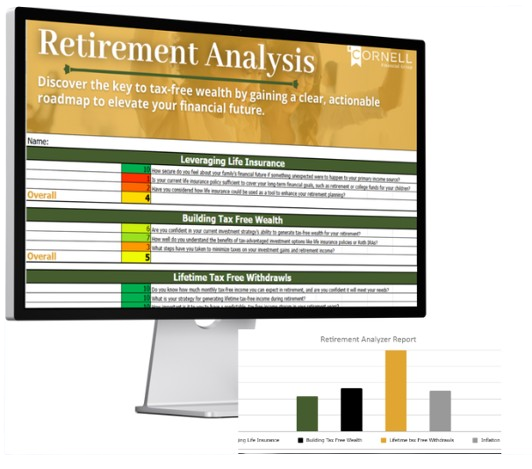
Schedule a Retirement Analysisreview with Cornell Financial Group.

The Generation That Shall Not Pass Away
In “The Generation That Shall Not Pass Away,” Amir Tsarfati talks about why our generation should pay attention to what is happening in the world, especially when it comes to Israel and biblical prophecy. He explains Jesus’ words in Matthew 24 and connects them to Israel becoming a nation again and other events that he believes point toward the fulfillment of biblical prophecy. His message is that these events are not meant to make us panic, but they should make us think seriously about where we stand with God and whether we are spiritually prepared.
What really stands out is the reminder that we should not spend our time trying to guess the exact date of Jesus’ return. Instead, we should live as people who are ready for Him. Amir encourages Christians to stay close to God, know His Word, share the gospel, and not allow fear or everything happening around us to distract us from our faith. The message is ultimately about hope and readiness: the world may feel uncertain, but God is still in control, and His promises will not fail.

Creating Tax Free Wealth For Business Owners
Kai-Zen was first introduced in 2012 by NIW. The underlying financial approach has been utilized by wealthy individuals and estates (typically $10M and over) since the 1960s. Kai-Zen is a new variation on this approach - allowing highly compensated individuals like yourself to participate in this type of leveraging for the first time.
Learn More About Kai-Zen™
Take Comfort in Understanding Your Strategy!
No one knows what will happen in the future but looking at the past uncovers some common patterns. Stressing our designs through some of the harshest economic conditions to date allows us to implement a strategy to help protect against potential future failures and optimizes our chances for a more successful outcome.
"Let us not become weary in doing good, for at the proper time we will reap a harvest if we do not give up."
- Galatians 6:9 (NIV)
Home
Our Story
Kai-Zen™
Resources Center
Unlock the path to tax-free wealth and watch your business flourish like never before.


An Independent Licensed Agent Representing NIW Companies, Inc. Creators of The Kai-Zen Plan
Cornell Financial Group © Copyright 2026 | All Rights Reserved